
Today marked our final day in Berlin, and it was our most significant musical day yet! Our first schedule obligation was a three hour final rehearsal for our Mendelssohn Concert with the Junges Ensemble. The concert repertoire included Mendelssohn’s choral-orchestral works Psalm 42 and Die erste Walpurgisnacht, and the a cappella motet Denn er hat seinen Engeln (better known for being rearranged with orchestral accompaniment for Elijah, but it was an a cappella motet first!). Our rehearsal was at our performance space at the Philharmonie, and I must say it’s one of the most unique concert halls I’ve ever seen. It is incredibly angular, with audience sections encircling the orchestra stage. The choir was placed above the stage in a section of seats, so looking down to see the conductor forced us to be especially careful with our vocal technique due to the different posture.


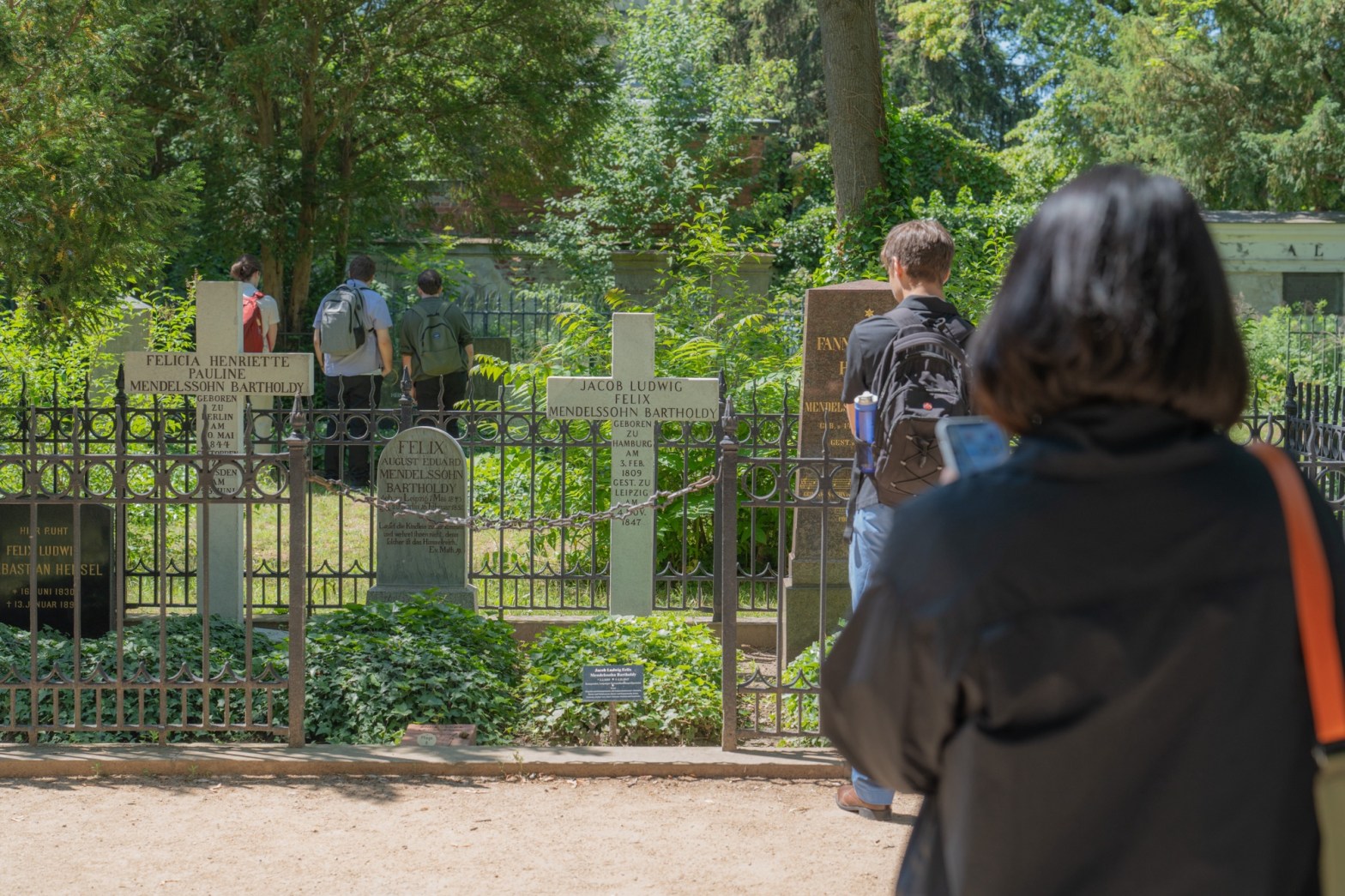
After the rehearsal, Cardinal Singers traveled as a group to Mendelssohn’s grave. Mendelssohn comes from one of the great 19th-century families of Berlin, and his grandfather founded a bank that grew into one of the largest in the city (I mentioned passing the bank building in a previous post). Mendelssohn’s sister Fanny was an accomplished composer and performer in her own right, though her music remains disappointingly but not surprisingly underperformed. They are buried next to each other in the grave site, along with some other members of the Mendelssohn family. The choir sang Denn er hat seinen Engeln at the grave, and then some older members (including me) who knew other works sang Ehre Sei Gott and some selections from Sechs Sprüche. There is perhaps no more fitting tribute for a composer than to perform their music at their grave, and I had chills the entire time. Mendelssohn’s legacy speaks for itself, and like any composer, I hope that someday my own music is remembered and performed after I’ve departed from this Earth. I’d like to think that my music can remain as an everlasting tribute not to me, but to the ideas and beauty around me I found so important and meaningful that I had no choice but to compose.


After leaving the gravesite, we had some free time until our evening call, so I got a late lunch at an Italian place next to our hotel. Then, it was time to return to the Philharmonie for the concert! I’ve found that Germans are much more precise about concert entry-exit logistics than American choirs, or at least Louisville choirs. We had an exact plan for how to enter, when to enter, when to sit down, when to stand, and even how to deliver flowers to the soloists and conductors when the performance was over (more on that later). At Louisville we do not enter in an exact order usually, and while the organization caused some undue stress for our members, it certainly looked efficient.
The concert was simply one of the most wonderful choral experiences I’ve ever had! The performances were excellent, and the audience gave as warm a reception as I’ve seen a German audience give (their audiences are far more subdued than American ones usually). I even heard some yells and whistles for the choir from the German audience! My performing experience in Germany is not extensive, but that was a first in approximately 10 concerts over two trips to Germany in the last few years. Our director Dr. Kent Hatteberg conducted Denn er hat seinen Engeln and Psalm 42, and the Junges Ensemble’s director Vinzenz Weissenburger conducted Die erste Walpurgisnacht.
I think many readers of this blog know Dr. Hatteberg, but to pay him a brief tribute, in addition to all of his accomplishments as a choral director (international competition victories, global #1 rankings in Interkultur’s ranking system, etc.), he is one of the foremost Mendelssohn scholars on the face of the Earth. He lived in Berlin for a few years in the 1990s specifically to research Mendelssohn, and through his discovery and application of writing from Mendelssohn about a previously unfinished work, he premiered a Mendelssohn work in the United States about 160 years after Mendelssohn passed! During his time living in Berlin, he attended performances at the Philharmonie regularly, and while Dr. Hatteberg is not one to throw around conducting venues in his bio (which are often simply pay-to-play: think a high school group going to Carnegie Hall), the chance to conduct on the stage he saw so many performances on while living in Berlin was significant. Now, for more on the flowers: I was one of the designated singers from the choir to deliver flowers to the soloists and conductors. By sheer luck of the order I walked out in, I got to give Dr. Hatteberg his flowers. There is perhaps no more important musical mentor and champion of my own music than Dr. Hatteberg, so the opportunity to pay him tribute after the concert means a lot to me!
Following the concert, the Junges Ensemble hosted us at a restaurant called Lindenbräu near the Philharmonie. The camaraderie our two choirs developed over the past few days cannot be overstated, and their kindness to us will not soon be forgotten. We enjoyed talking with our new German friends about our performance and the rest of our trip, and in true American choral fashion, we even had some barbershop tags break out between members of the choirs! My traveling group returned to the hotel at about 1:00 AM, and I will confess that this is the first blog post I did not finish before the next day began. As I write this, I am on a train towards Leipzig, which is Bach’s hometown! I’m sad to leave Berlin but thrilled to explore Leipzig, and I’ll look forward to updating you on new experiences soon. As a last note, you may have noticed I’ve been using several photos from Jackson Scott the last few days. Jackson is a gifted tenor in Cardinal Singers, exceptional photographer, and even better friend, so I want to give him due credit for providing so many photos for my posts!


Leave a Reply