
Traveling with a group this large is always something akin to herding cats. Through no fault of the group, making sure a 30+ person choir gets from Louisville, KY, to Berlin, Germany is an exercise in both patience and endurance. Our flights from Louisville to Newark and Newark to Frankfurt were thankfully seamless! We had several members flying for the first time in their lives and/or visiting another country for the first time, and it’s always heartwarming to see older members of the choir offer tips and encouragement for dealing with the travel. After arriving in Frankfurt, waiting for everyone’s luggage, and getting through German customs, all that we had left to get to Berlin was a train ride.
Our train was scheduled to depart from the Frankfurt airport around noon. We departed on time, but then delays outside of our control began. In the days preceding our arrival, torrential rainfall caused flooding in southern Germany, blocking rail lines and throwing the rail infrastructure into disarray. The flooding caused multiple lines and schedules to be consolidated, and we had several delays that resulted in us not arriving in Berlin until nearly 9:00 PM local time. Next, we had to take the Berlin subway system (the U-Bahn) to get to our hotel. Public transit in Berlin is wonderful, but making sure this many students get on and off of trains before the doors close is enough to make a director (and the graduate students) pull their hair out! Once we arrived at the hotel, every Cardinal Singer experienced what was surely the best shower of their lives after nearly 30 hours of total travel time without much sleep! To cap off the night, lots of singers went to a kebab stand around the corner, and the owners graciously entertained sleep-deprived American college students stammering through broken German in a valiant effort to order kebabs, döner, schnitzel, and currywurst.
After the best night of sleep I can remember since the last time I traveled internationally (there is no exhaustion like travel exhaustion), the singers got breakfast at the hotel and started about our day. First on the agenda was a two-and-a-half-hour rehearsal at a church about 30 minutes away via public transit (we have a concert at the church on the evening of June 6th). After herding cats (or more fittingly cardinals) yet again through public transit we got our first look at the church. I’m convinced I could spend a year in Berlin seeking out historic churches and not find every single one. It seems as if every corner has a church dating back centuries and holding rich history and beauty inside. This church, Evangelische Luisenkirche, is a Lutheran church that was built in 1710 and is relatively new by German standards. One of my duties as a graduate student is serving as the choral rehearsal accompanist when needed, and I had the privilege of playing the church’s piano while we were rehearsing two Mendelssohn orchestral pieces we’re performing later in the week.


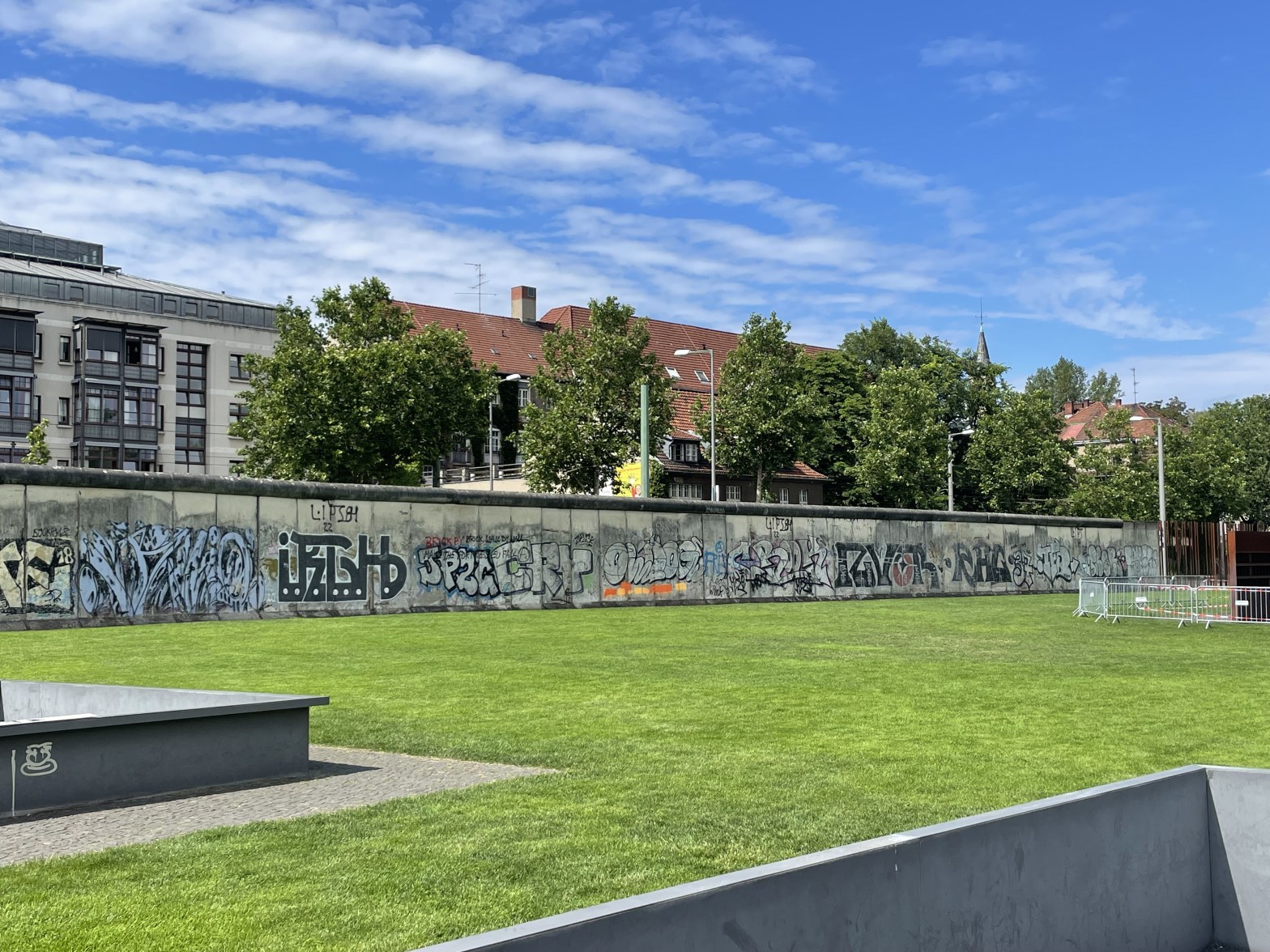
Following the rehearsal, a small group of us set out for the day to get lunch and begin sightseeing. I’ve been to Berlin briefly before, but today I saw the Berlin Wall with my own eyes for the first time. My group traveled to a memorial site with more information, and I learned that a cemetery was blocked by the building of the wall. I spent some time walking through the cemetery that lies within the ruins, and since the space was blocked for decades, I couldn’t help but wonder how many families were prevented from tending to their loved ones’ graves lest they risk being put in those graves themselves. More than blocking east and west Berlin geographically, the USSR hoped the wall would cause eastern Berliners to forget their western counterparts throughout generations and become further and further removed from their lineages to mold into a Soviet satellite city. Families were separated by the wall and well over 100 people died attempting to reunite, but denying Germans with ties to that cemetery the chance to respect their dead was a uniquely cruel twist of the knife in the story of the Berlin Wall.


On Christmas Day, 1989, in honor of the wall coming down, Leonard Bernstein conducted an orchestra and choir on Beethoven’s 9th Symphony, universally known as the “Ode to Joy” symphony. In celebration of the reunification of Berlin and Germany, Bernstein changed the text to say Freiheit (freedom) instead of Freude (Joy). I was nearly moved to tears today picturing eastern and western Berliners alike joining forces to sing in celebration of their freedom at the site of the wall some 35 years ago. In some similar sense, I’m given chills to think that I’ve traveled halfway around the world solely to make music with German choirs consisting of members I don’t personally know. To save funding for music in American schools, music is often shown in concise graphs raising test scores in STEM areas. I’ve never once seen funding for a science program be justified by the students’ increased proficiency in music. Why is my career’s value determined by how it affects other academic areas of study? Why do we time and time again fail to value music for music’s sake and resort to cheap graphs begging with our hands out to be considered equals?
If you want an example of music’s value, look no further than Bernstein celebrating “Freiheit” in Berlin. Look no further than human heart by human heart being moved in concert halls. The Berlin Wall blocked physical access to either side of the city and even prevented Berliners from looking after their dead, but no wall could ever stop the sounds of German hymns and folk songs drifting through the air. A music-making people are a free people, and it’s no coincidence that when freedoms are threatened across the globe, the arts are the first thing to be restricted. Now, in this place, making music in the present day but gazing back into centuries of human history to reflect on and grow from, I feel that all I have any desire to do is give thanks. I’m beyond grateful for the chance to experience this place and make music with its people, and here’s to the hope that we embolden the world around us to do the same and remember its common humanity in the process.


Leave a Reply